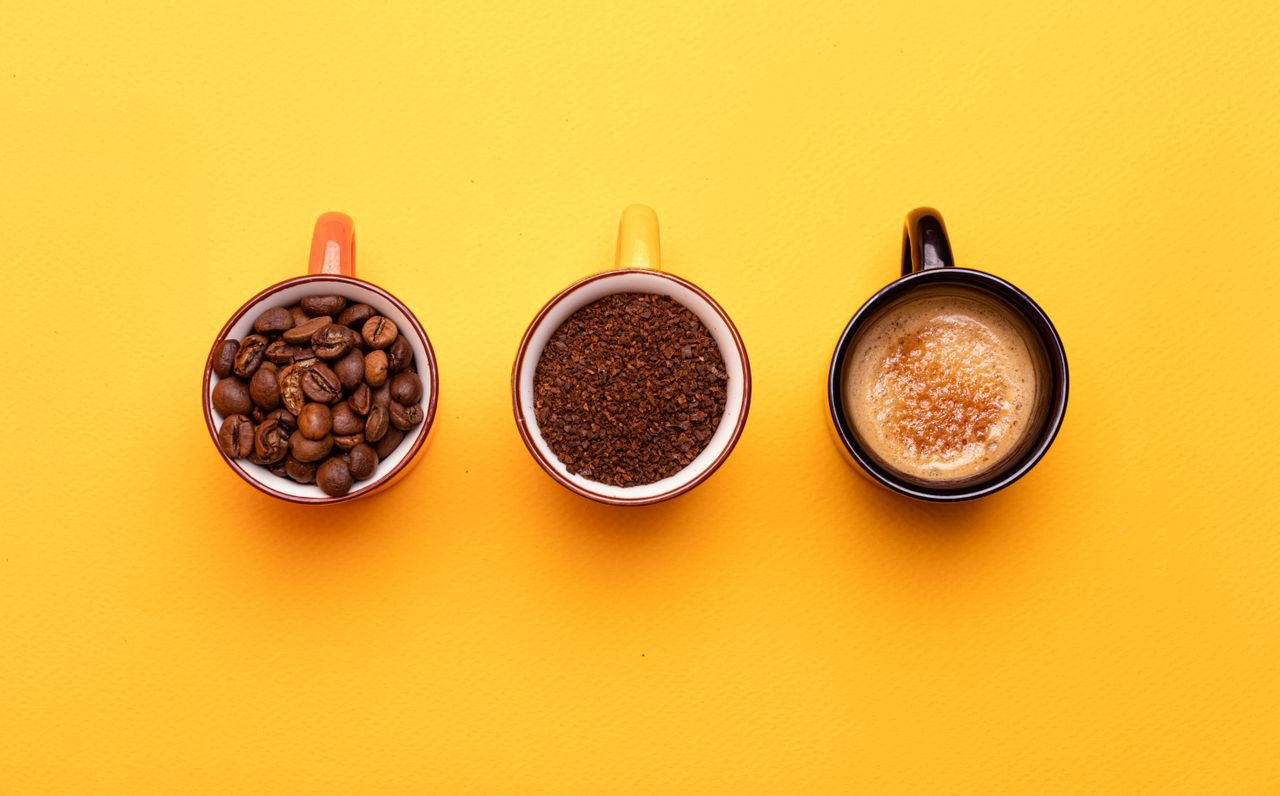
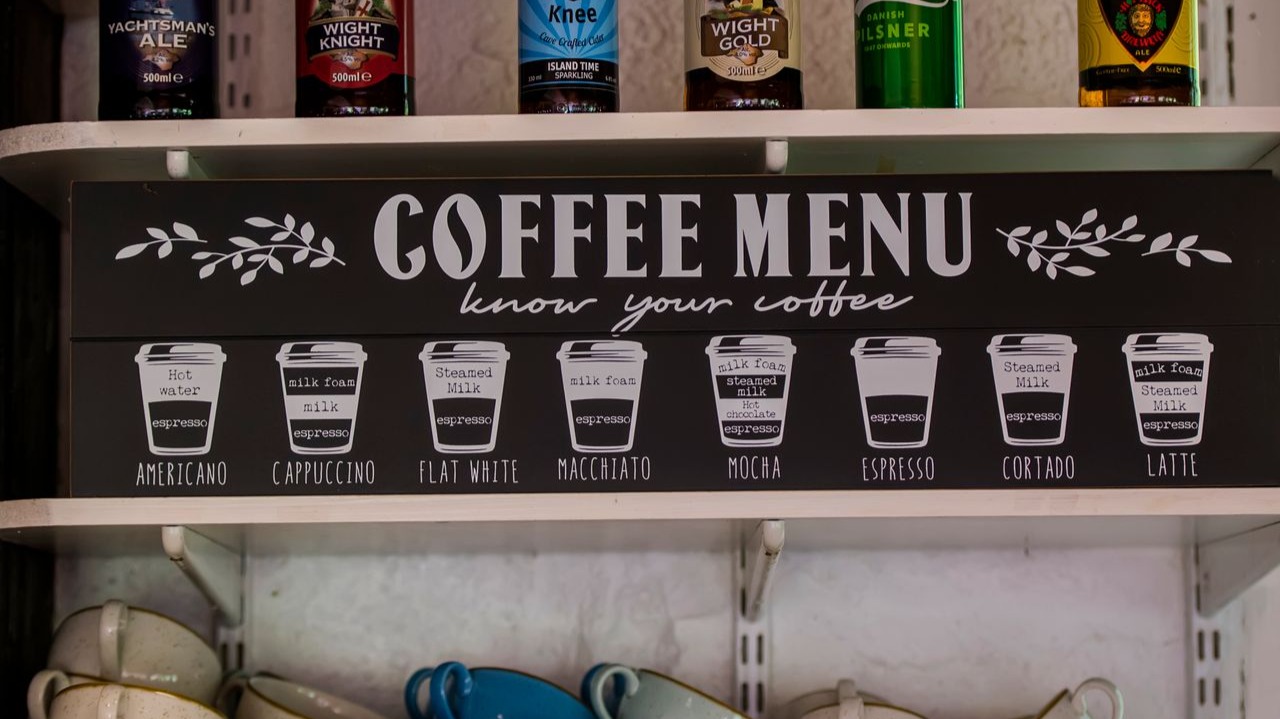
You step up to the counter, glance at the board, and there they are: latte, cappuccino, flat white, cortado, macchiato, americano. They all seem to be coffee with milk, more or less, so what is the actual difference? And why does the flat white cost about the same as the latte when it comes in a smaller cup?
Here is the reassuring part. Almost every drink on a coffee menu is built from the same short list of ingredients, so once you know those, the whole board turns into a set of simple recipes. This guide explains the building blocks first, then walks through each drink, group by group, with a quick comparison table for each so you can see the differences at a glance.
The building blocks
Nearly every hot coffee drink is some combination of four things. Learn these, and the rest falls into place.
Espresso. A small, concentrated shot of coffee, made by forcing hot water through finely ground coffee under pressure. A single shot is usually around 25 to 30 millilitres. It is the base of almost every drink below, so "one shot" or "two shots" refers to this.
Hot water. Just-off-the-boil water, used to lengthen and soften espresso without adding milk.
Steamed milk. Milk heated and gently textured with steam until warm and slightly sweet. This is the bulk of most milky drinks.
Foam. The airy top layer created while steaming. Traditional foam is light and bubbly, like a soft meringue. Microfoam is finer and glossier, closer to wet paint, and blends smoothly into the milk. How much foam a drink has, and which texture, is often the main thing that sets two drinks apart.
Everything below comes down to how much espresso, water, milk, and foam go in, and in what proportion.
The espresso shots
The pure coffee options, with no milk and no added water. They differ by how much water passes through the coffee.
Drink | How it is made | Character |
|---|---|---|
Espresso | A standard single shot, about 25 to 30 ml | Concentrated and balanced |
Doppio | A double shot | Same character, twice the volume |
Ristretto | Less water, a shorter pull | Smaller, sweeter, rounder |
Lungo | More water, a longer pull | Larger, more bitter |
Espresso is a single concentrated shot, served on its own in a small cup, sometimes called a short black. Doppio is simply a double ("doppio" is Italian for double), and it is the default base for milky drinks in many cafes. Ristretto is a "restricted" shot pulled with less water, which makes it sweeter and rounder with less bitterness, espresso's short, intense sibling. Lungo ("long") is the opposite, pulled with more water, and because that extra water draws out later flavours it tastes more bitter rather than simply weaker.
Coffee with water
Add hot water to espresso and you get a longer, softer black coffee. Two names come up, and the difference is mostly the order they go in the cup.
Drink | How it is made | Character |
|---|---|---|
Americano | Espresso first, then hot water on top | Smooth, softened espresso |
Long black | Hot water first, then espresso on top | Similar, but brighter with more crema |
Americano is espresso topped up with hot water to the length you like, keeping the espresso character but gentler than the shot alone. Long black uses the same two ingredients in reverse, water first and espresso poured over, which keeps more of the crema (the golden layer on a fresh shot) intact, so it often tastes a touch brighter and more aromatic. The difference is subtle, and some cafes use the names interchangeably.
The milk drinks
This is where most of the confusion lives, because these drinks share the same ingredients and differ mainly in proportion. As a rough rule, the more milk relative to coffee, the milder the drink. The figures below are approximate and vary from cafe to cafe.
Drink | Espresso | Steamed milk | Foam | Typical size | Character |
|---|---|---|---|---|---|
Macchiato | 1 shot | A dash | Tiny | ~40 ml | Bold, barely milky |
Cortado | 1 shot | Roughly equal to the espresso | Minimal | ~120 ml | Smooth but coffee-forward |
Piccolo | 1 shot (often ristretto) | Small | Thin microfoam | ~90 ml | A small, strong mini-latte |
Flat white | 1 to 2 shots | Moderate | Thin microfoam | ~150 ml | Strong, silky |
Cappuccino | 1 to 2 shots | About one third | About one third, airy | ~160 ml | Balanced and frothy |
Caffe latte | 1 to 2 shots | Large | Thin cap | ~250 ml | Mild and creamy |
Latte macchiato | 1 shot | Large (milk first) | Layered | ~250 ml | Milkiest, coffee as an accent |
Caffe mocha | 1 to 2 shots | Large, plus chocolate | Light | ~300 ml | Sweet, rich, chocolatey |
Macchiato means "stained": a shot of espresso with just a spoonful of milk or foam to mark it, so it stays close to a straight espresso. (Note the "latte macchiato" further down is a very different, milky drink, and some chains use "macchiato" for large sweet drinks that bear little resemblance to the original.)
Cortado is espresso cut with a roughly equal amount of warm milk and very little foam, often in a small glass. The milk softens the intensity while keeping it clearly coffee-forward.
Piccolo is essentially a miniature latte: a single shot (often a ristretto) with a little steamed milk and microfoam, giving the silky quality of a latte but with the coffee more concentrated.
Flat white is espresso with steamed milk and only a thin layer of microfoam. Compared with a latte it uses less milk and less foam, with silkier texture, so the coffee comes through more strongly. It is usually served in a smaller cup, which is why it can look like less coffee for similar money even when it holds just as much espresso.
Caffe latte is the most milk-forward classic: espresso with a large amount of steamed milk and a thin cap of foam, making it the mildest and creamiest of the group. ("Latte" alone means "milk" in Italian, so ordering one in Italy may get you exactly that.)
Cappuccino is the balanced classic, traditionally three roughly equal parts espresso, steamed milk, and foam. That generous, airy foam is its signature and makes it feel lighter than a flat white or latte, while the smaller amount of milk lets the coffee come through more clearly.
Latte macchiato is the reverse of a normal latte: the glass is filled with steamed milk first, then a shot is poured through it, staining the milk in visible layers. The result is even milkier and gentler, with the coffee as an accent.
Caffe mocha is a latte with chocolate, whether cocoa powder, syrup, or melted chocolate, sitting between a coffee and a hot chocolate and often finished with foam or cream.
The cold ones
Cold coffee is not simply hot coffee left to cool, because the method changes the taste.
Drink | How it is made | Character |
|---|---|---|
Iced coffee | Hot-brewed coffee or espresso, chilled and poured over ice | Simple and refreshing |
Iced latte | Espresso with cold milk over ice | Milky, but not creamy like a hot latte |
Cold brew | Coarse grounds steeped in cold water for 12 to 24 hours, then filtered | Smooth, low in acidity, naturally sweeter |
Nitro cold brew | Cold brew infused with nitrogen, poured from a tap | Creamy, foamy head, no milk added |
Affogato | A shot of hot espresso poured over ice cream | A hot-and-cold dessert |
Iced coffee is the general term for coffee served cold over ice, usually brewed hot then cooled. Iced latte is espresso with cold (not steamed) milk over ice, so it is less creamy than a hot latte but similarly milky. Cold brew is a different method entirely, steeped cold for many hours, which pulls out flavour gently and gives a smooth, low-acid, naturally sweeter result. Nitro cold brew is cold brew charged with nitrogen for a creamy texture and a cascading, stout-like head, served without ice. Affogato ("drowned") is really a dessert: espresso poured over vanilla ice cream for hot and cold, bitter and sweet, in one spoon.
A quick reference recap
The whole menu at a glance, ordered from the strongest coffee character to the mildest.
Drink | In short | Milk level |
|---|---|---|
Espresso | A concentrated shot | None |
Ristretto | A shorter, sweeter shot | None |
Lungo | A longer, more bitter shot | None |
Doppio | A double espresso | None |
Macchiato | Espresso with a mark of milk | A dash |
Americano / long black | Espresso lengthened with hot water | None |
Cortado | Roughly equal espresso and warm milk | Low |
Piccolo | A small, strong mini-latte | Low |
Flat white | Espresso, steamed milk, thin microfoam | Medium |
Cappuccino | Equal espresso, milk, and airy foam | Medium |
Caffe latte | Lots of steamed milk, a little foam | High |
Latte macchiato | Steamed milk stained with espresso | Highest |
Caffe mocha | A latte with chocolate | High |
Cold brew / nitro / iced | The cold-served options | Varies |
Frequently asked questions
What is the difference between a latte and a flat white? Mostly the amount of milk and foam. A latte uses more steamed milk and a light foam cap, so it tastes milder and creamier. A flat white uses less milk and only a thin layer of silky microfoam, so the coffee comes through more strongly and the texture is more velvety. Both usually start from the same espresso, and the flat white is typically served in a smaller cup.
Is a cappuccino stronger than a latte? They generally contain the same amount of espresso, so the caffeine is often similar. A cappuccino tastes stronger because it has less milk to dilute the coffee, plus a thick foam layer, while a latte has much more milk and so tastes milder. "Stronger" here is about flavour, not necessarily caffeine.
What is the difference between an americano and a long black? The same two ingredients, espresso and hot water, in the opposite order. An americano is espresso with water added on top; a long black is water with espresso poured over it. Pouring the espresso last preserves more of the crema, so a long black can taste slightly brighter. Many places treat the names as interchangeable.
Is cold brew just iced coffee? No. Iced coffee is usually brewed hot and then cooled over ice. Cold brew is steeped in cold water for many hours and never brewed hot, which gives it a smoother, less acidic, naturally sweeter taste. They are made differently and taste different.
Key takeaways
Almost every coffee drink is built from four things: espresso, hot water, steamed milk, and foam.
The espresso shots (espresso, doppio, ristretto, lungo) differ by how much water passes through the coffee and how concentrated the result is.
Add hot water and you get an americano or long black, which differ mainly in which goes into the cup first.
Among milk drinks, the difference is proportion: more milk and foam make a drink milder (latte), less milk with silky microfoam makes it stronger and smoother (flat white), and equal parts espresso, milk, and foam make a cappuccino.
Cold coffee is its own category, and cold brew in particular is a distinct method, not simply chilled coffee.