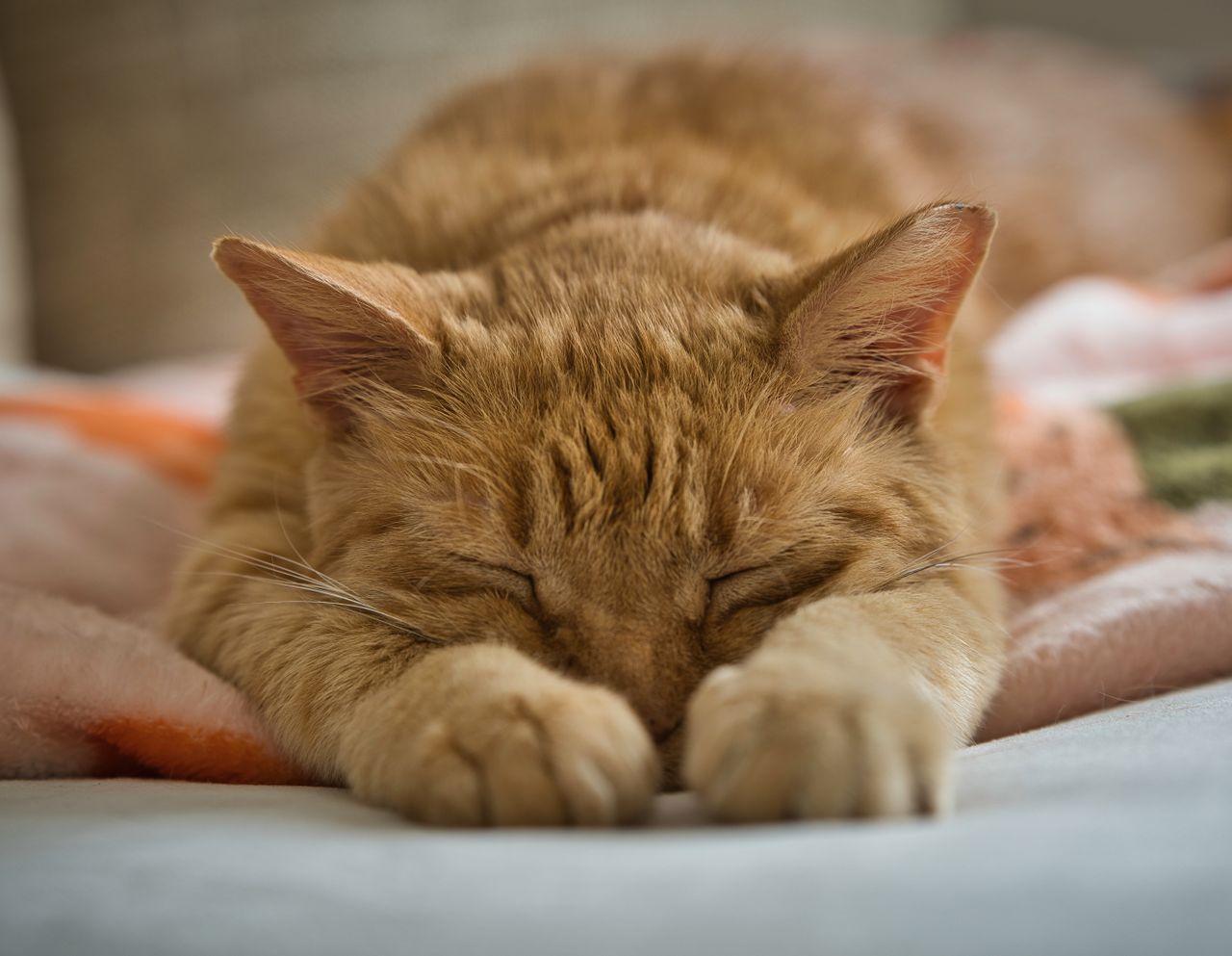
Your cat settles into your lap, half closes its eyes, and starts up that warm, rumbling engine. It feels like the clearest signal in the world: this is a happy cat. And most of the time, you would be right.
But "most of the time" is not "always," and that gap is worth knowing about. Cats also purr in moments that have nothing to do with contentment, including some when they are frightened, hurting, or trying to get something out of you. The purr is less a happiness meter and more a piece of feline language with several meanings. Once you can read it in context, you understand your cat a little better, and you are better placed to notice when a purr is telling you something is wrong.
Why this is worth getting right
It is a lovely idea that a purring cat is always a content one, but taken literally it can mislead you. A cat purring at the vet or curled up unusually quietly may look reassuring while actually coping with stress or pain. If you read every purr as happiness, you can miss the moments your cat most needs you to notice.
None of this makes the purr less delightful. It just means treating it as one clue among several rather than the whole story. That small shift makes you a more attentive owner, which is the whole point.
What a purr actually is
A purr is a soft, low rumble a cat makes on both the in-breath and the out-breath, which is part of what makes it so continuous and distinctive. It sits at a very low frequency, and here the science recently got more interesting.
For about fifty years, the leading explanation was that cats actively twitch the muscles of their voice box up to around thirty times a second, with the brain driving every beat. A 2023 study led by Christian Herbst, published in Current Biology, complicated that picture. Working with larynges from deceased cats, the researchers pushed warm air through them and produced purr-like sounds at roughly 25 to 30 hertz with no brain and no muscle twitching involved. They found dense connective tissue "pads" in the vocal folds that let a small animal produce such a low sound on its own (Herbst et al., 2023).
That does not mean the brain plays no role, and the authors were careful about this. One reviewer compared studying a removed larynx to analysing a wind instrument's mouthpiece on its own. What it does suggest is that purring may be more of a built-in, semi-automatic mechanism than a moment-by-moment emotional readout, which fits neatly with the fact that cats purr in so many different situations.
What the evidence actually says about why cats purr
Contentment, the reason you already know
Start with the happy news, because it is real. Cats very often purr when they are relaxed, comfortable, and enjoying attention. If your cat is loose-limbed, kneading, and blinking slowly in your lap, the purr almost certainly means exactly what you think it does. This is the most common purr, and there is nothing wrong with enjoying it at face value.
Self-soothing when stressed or in pain
The purr is also a coping tool. Vets and behaviourists note that cats purr when they are anxious, unwell, injured, giving birth, and sometimes even when close to death. The leading explanation is self-soothing: the purr appears to help a stressed cat calm itself, a bit like a person humming to steady their nerves (Catster, vet-reviewed by Dr. Lorna Whittemore). This is why a cat can purr on the vet's table while clearly tense. The purr is not saying "I am happy here," it is saying "I am trying to cope."
A kitten's first form of communication
Purring starts remarkably early. Kittens are born blind and deaf and begin purring within days, using it to bond with their mother and signal where they are during nursing. Mother cats purr back. So one of the purr's oldest jobs has nothing to do with human company at all. It is a channel of reassurance between cat and cat.
The clever "feed me" purr
This is the one that tends to surprise people. In a 2009 study at the University of Sussex, Dr. Karen McComb and colleagues identified a "solicitation purr," a purr cats use when they want something, usually food. Hidden inside the normal low rumble is a higher-pitched cry, not unlike a meow or even a human baby's cry. When people listened, they rated these purrs as more urgent and less pleasant, even when they could not say why (McComb et al., 2009).
In other words, some cats have learned to fold an insistent "feed me" into a sound we associate with affection, which is a quietly brilliant piece of manipulation. Tellingly, cats tend to use this purr one-on-one with their own person, often at inconvenient hours, and rarely around strangers.
The healing idea, treated honestly
You may have read that purring physically heals cats, on the basis that its low frequencies, often quoted as around 25 to 150 hertz, match ranges linked to bone and tissue repair. The idea was popularised by bioacoustics researcher Elizabeth von Muggenthaler, and it is genuinely intriguing.
It is also, so far, a hypothesis rather than an established fact. The supporting studies are small, and there is no solid proof that purring meaningfully heals bones in living cats, let alone in humans holding them. It is fair to find the idea fascinating. It is not fair to state it as settled science, and POKO would rather tell you where the evidence actually stands than repeat a comforting claim uncritically.
How to actually read your cat's purr
The single most useful habit is to stop reading the purr on its own and start reading it together with everything else your cat is doing.
Watch the body, not just the sound. A relaxed body, soft eyes, and gentle kneading point to a content purr. Flattened ears, a tense crouch, a tucked tail, panting, or wide eyes alongside a purr suggest stress rather than joy.
Use context. A purr on the sofa after dinner is almost certainly contentment. A purr at the vet, after an injury, or in a frightened cat is more likely self-soothing.
Learn your own cat's "feed me" purr. If a particular purr shows up right at mealtimes and sounds slightly more urgent or grating, you are probably hearing a solicitation purr. It is fine to respond, just be aware you are being asked, not simply adored.
Treat a purring but unwell cat seriously. Because cats purr through pain, never use "but they were purring" as reassurance that a hurt or sick cat is fine. If something else seems off, let the other signs guide you to your vet.
Common mistakes to avoid
Assuming every purr means happiness. It usually does, but a stressed or hurting cat can purr too, and missing that is the real risk.
Dismissing a sick cat's discomfort because it is purring. Purring is a coping mechanism, not proof of wellbeing. Judge by the whole picture.
Repeating the "purring heals bones" claim as fact. It is an interesting hypothesis, not confirmed science, so it is worth enjoying with a pinch of salt.
Ignoring body language. The purr is one channel. Ears, eyes, posture, and tail usually tell you more about how your cat actually feels.
Frequently asked questions
Do cats purr when they are in pain? Yes. Cats can purr when injured, ill, or giving birth, most likely as a way to self-soothe. That is exactly why a purr alone should never reassure you that a cat in obvious distress is fine.
Can I tell a happy purr from a stressed one? Not reliably from the sound alone, though stressed and solicitation purrs can sound slightly more urgent. Body language and context are far more dependable guides.
Why does my cat purr and then bite or meow at me? Often because the purr was a request rather than pure affection, particularly around food or attention. A solicitation purr can sit right next to more direct demands like meowing or a nip.
Do all cats purr? Most domestic cats do, but not all individuals purr equally, and some big cats cannot purr in the same way at all. A quieter cat is not an unhappy one.
Is purring good for the cat? Purring clearly helps cats communicate and seems to help them self-soothe. The stronger claim that it physically heals their bodies remains an unproven hypothesis.
Key takeaways
So, do cats purr only when they are happy? No. Contentment is the most common reason, and often the right reading, but it is not the only one. Cats also purr to soothe themselves when stressed or in pain, to communicate as kittens, and sometimes to nudge you into the kitchen with a cleverly disguised "feed me" purr. Even the mechanics are more automatic than emotional, according to recent research. The takeaway is not to trust the purr less, but to read it in context: enjoy the happy ones, respond to the hungry ones, and never let a purr talk you out of checking on a cat that otherwise seems unwell.
Related PetalPoko articles
Why Does My Cat Sleep on Me? What the Science Actually Suggests
Why Do Dogs Tilt Their Heads When You Talk to Them?
How to Tell If Your Cat Is Stressed, and What Helps
Sources and further reading
McComb, K. et al. (2009), The cry embedded within the purr (solicitation purring study), Current Biology / University of Sussex. https://www.sussex.ac.uk/broadcast/read/1208
Herbst, C. T. et al. (2023), Domestic cat larynges can produce purring frequencies without neural input, Current Biology. https://www.cell.com/current-biology/fulltext/S0960-9822(23)01230-7
Catster (vet-reviewed by Dr. Lorna Whittemore, BVMS, MRCVS), Do Cats Purr When They Are Stressed or Nervous? https://www.catster.com/cat-behavior/do-cats-purr-when-stressed-nervous/
von Muggenthaler, E., The felid purr: A healing mechanism?, Journal of the Acoustical Society of America (healing-frequency hypothesis, unproven). https://pubs.aip.org/asa/jasa/article/110/5_Supplement/2666/550913/