Just before eight in the evening, a lane in Taipei begins to fill. People drift out of doorways and lift, carrying bags in both hands, and stand at the kerb the way you might wait for a bus. Then, from somewhere around the corner, comes the tinny, unmistakable opening of Beethoven's "Für Elise". A yellow truck rolls into view, playing the tune like an ice cream van. Behind it comes a second truck for the recycling. Neighbours toss their sorted bags up to the crew, swap a few words, and go back inside. It happens most nights of the week, in thousands of spots across the city, and to anyone who grew up there it is simply the sound of the day ending.
It is easy to mistake this for a quaint local habit. It is closer to the visible surface of one of the more remarkable turnarounds in modern waste management, and it began somewhere far less charming.
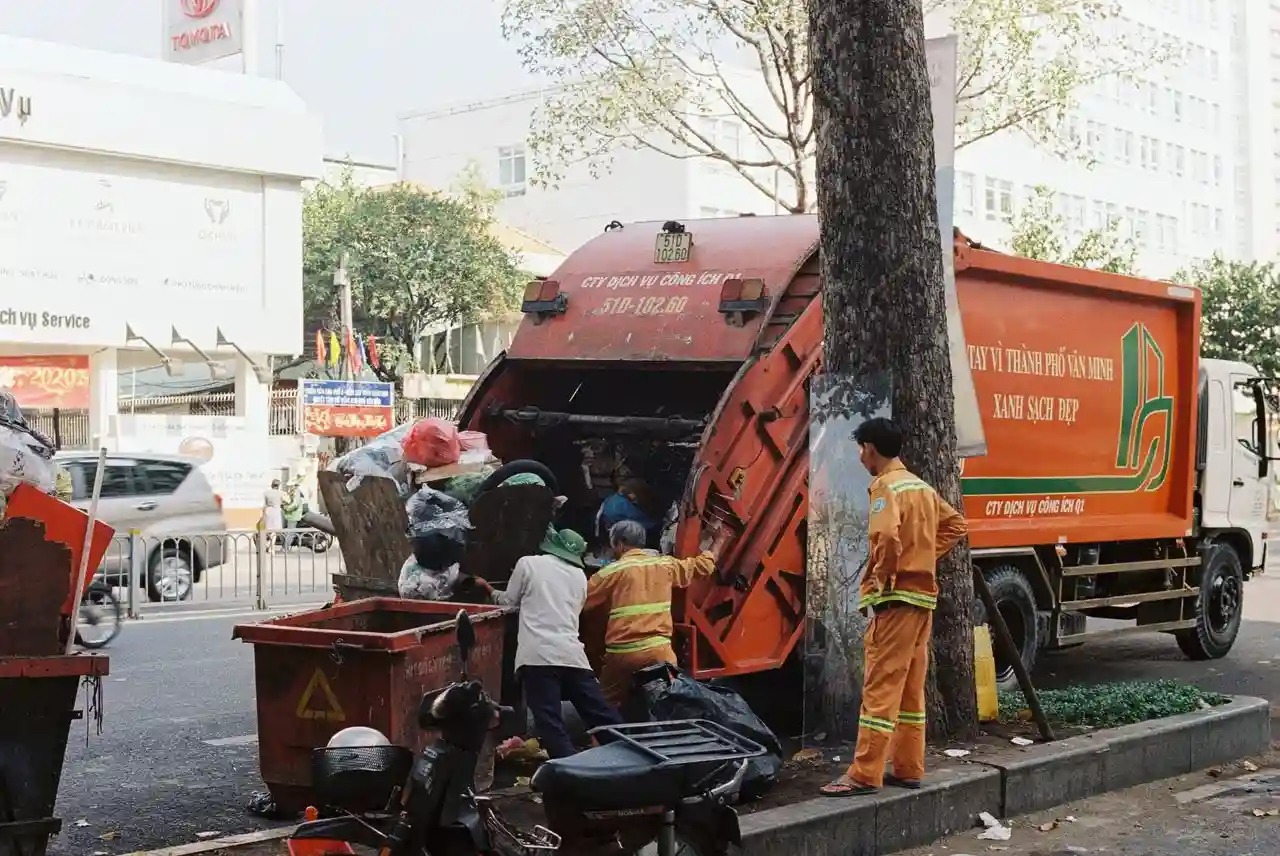
Thirty years ago, Taiwan had a nickname it did not enjoy. People called it "Garbage Island". The label was not unfair. In 1993, according to figures cited by Smithsonian magazine, the island collected only around 70 percent of its rubbish, which meant roughly a third of it was burned in backyards or simply left where it fell. By the mid-1990s two-thirds of Taiwan's landfills were full or close to it. A fast-growing economy had produced a fast-growing mountain of waste, and there was nowhere left to put it. Rubbish piled up on street corners and riverbanks. The air near the tips was hard to breathe.
The government's first instinct was the one most governments reach for. If you cannot bury the waste, burn it. Plans were drawn up, first for twenty-one large incinerators in 1990, then for fifteen more in 1996. It was an infrastructure answer to what turned out to be a behaviour problem, and it did not go unchallenged.
Some of the sharpest resistance came from an unlikely quarter. In 1987 a group of ten women had founded an organisation called Homemakers United, worried about the environment their children were growing up in. Rather than simply oppose the incinerators, they did something more persuasive. They petitioned the authorities with a calculation: that around 40 percent of the island's municipal waste could be recycled, and another 35 percent composted. In other words, most of what Taiwan was preparing to burn or bury did not need to be waste at all. It was a resource that had been thrown into the wrong pile.
That argument, repeated and pushed over years, helped shift the whole approach. The legal groundwork had actually been laid a little earlier. Taiwan's Waste Disposal Act of 1988 introduced the principle of extended producer responsibility, which put the financial burden of recycling onto the manufacturers and importers who made the packaging in the first place, rather than onto councils alone. In 1997 this was reshaped into what became known as the "4-in-1" recycling programme, a system that tied together four parties who each had to do their bit: residents who sorted, local authorities who collected, recycling companies who processed, and a fund, paid into by manufacturers, that kept the whole thing solvent.
The genius of it, and the reason those evening queues matter, was that the system refused to let anyone off the hook. In most of the wealthy world, recycling is something you do in private. You put a bin out, it disappears, and you never think about it again. Taiwan built the opposite. In much of the island there is no communal bin on the street to quietly absorb your bad habits. If you want to throw something away, you have to carry it out, in person, to a truck that comes at a set time, and hand it over in front of your neighbours. Non-recyclable rubbish has to go in official, government-certified bags that you pay for, so the more general waste you produce, the more it costs you. Recycling, sorted properly, is collected for free.
This is where the classical music comes in, and it is worth being honest that even Taiwan is not entirely sure why. The singing trucks were introduced in 1997. One account, repeated in reporting by Undark, holds that a health official once heard his daughter practising "Für Elise" on the piano and thought the melody would make a gentle summons. Another suggests the trucks simply arrived pre-programmed with the tunes. Alongside Beethoven, the trucks play "A Maiden's Prayer" by the Polish composer Tekla Bądarzewska. The precise origin has been lost, but the effect is not in doubt. The music turns a chore into a small daily ritual, an appointment the whole street keeps together.
The sorting itself is more demanding than the single mixed bin many of us are used to. Households separate recyclables from general waste, and separate food waste on top of that, sometimes into raw scraps and cooked scraps, because the two have historically gone to different places. For years a large share of Taiwan's kitchen waste was cooked down and fed to pigs, with the rest turned into compost. It was a genuinely circular arrangement, the sort of loop that sounds almost too tidy to be real.
And the numbers moved. Taiwan's Environmental Protection Administration reports a recycling rate of around 55 percent for household and commercial waste, and higher still, around 77 percent, for industrial waste. The amount of rubbish each person throws away fell sharply, from roughly 1.2 kilograms a day to around 850 grams, according to figures reported by Smithsonian and Ensia. In Taipei the drop was steeper, down about 31 percent between 1997 and 2015. For a densely populated island with limited land, these are not small achievements. Ming-Chien Su, a professor at National Dong Hwa University, put the lesson plainly to Smithsonian: developing an effective waste policy, he said, "is a question of will, and not only wealth".
It would be easy to stop there, on the clean and cheering note. A publication built on trust cannot quite let itself.
The honest picture has shadows in it. Those headline recycling rates have been questioned, and some observers argue the official figures are flattering. There have been documented cases of ash from the incinerators, the very furnaces the reforms were partly meant to reduce, being dumped illegally. When China closed its doors to imported plastic scrap in 2018, waste that used to flow there washed up elsewhere, Taiwan included, straining a system that was never designed to be the world's recycling bin. And composite materials, the crisps packets and coffee cups fused from several substances at once, remain almost as difficult to deal with in Taipei as they are anywhere else.
Even the tidy loop of food waste has frayed. In October 2025 an outbreak of African swine fever was confirmed at a pig farm in Taichung, and feeding kitchen scraps to pigs suddenly looked less like recycling and more like a biosecurity risk. From January 2026 household food waste was barred from pig feed, with a full nationwide ban planned for 2027, according to reporting by Eco-Business. Taiwan now produces well over two thousand tonnes of food waste a day and has to find new homes for the share the pigs used to take. Composting costs have jumped, and officials have been candid that burning some of it is, for now, an emergency measure rather than a solution. Deputy Environment Minister Shen Chih-hsu said as much: incineration, he noted, "is only an emergency measure". A system that took thirty years to build is still being rebuilt in real time.
None of that erases what happened. It complicates the fairy tale, which is a different thing. Taiwan did not discover a magic technology or a material that makes waste vanish. It did something slower and, in a way, harder. It made throwing things away a public act, gave the responsibility back to the people and the companies who created the rubbish, and then held that arrangement in place, year after year, long enough for it to become ordinary. Lai Ying-ying, who has led waste management work at the island's environmental agency, described the real goal as getting waste disposal to "sit firmly in the public consciousness". That is not a policy you can buy. It is a habit a whole society has to agree to keep.
Which is perhaps the quiet lesson standing at the kerb in the evening light. Recycling, done seriously, is not really about bins or trucks or even rates. It is about a country deciding, together and out loud, that its rubbish is its own to answer for. The music helps. But the music was only ever the sound of people showing up.
Related PetalPoko articles
What Actually Happens to Your Recycling After the Truck Leaves
What Plastic Recycling Numbers Really Mean (and Which Ones Actually Get Recycled)
Sources and further reading
How Taiwan Has Achieved One of the Highest Recycling Rates in the World, Smithsonian Magazine
Taiwan's Transition, from Garbage Island to Recycling Leader, Rapid Transition Alliance
How Taiwan achieved one of the highest recycling rates in the world, Ensia
Beethoven's 'Für Elise' alerts Taiwanese residents to take out their trash, Classic FM
Taiwan phases out food waste as pig feed, sparking race to boost recycling capacity, Eco-Business