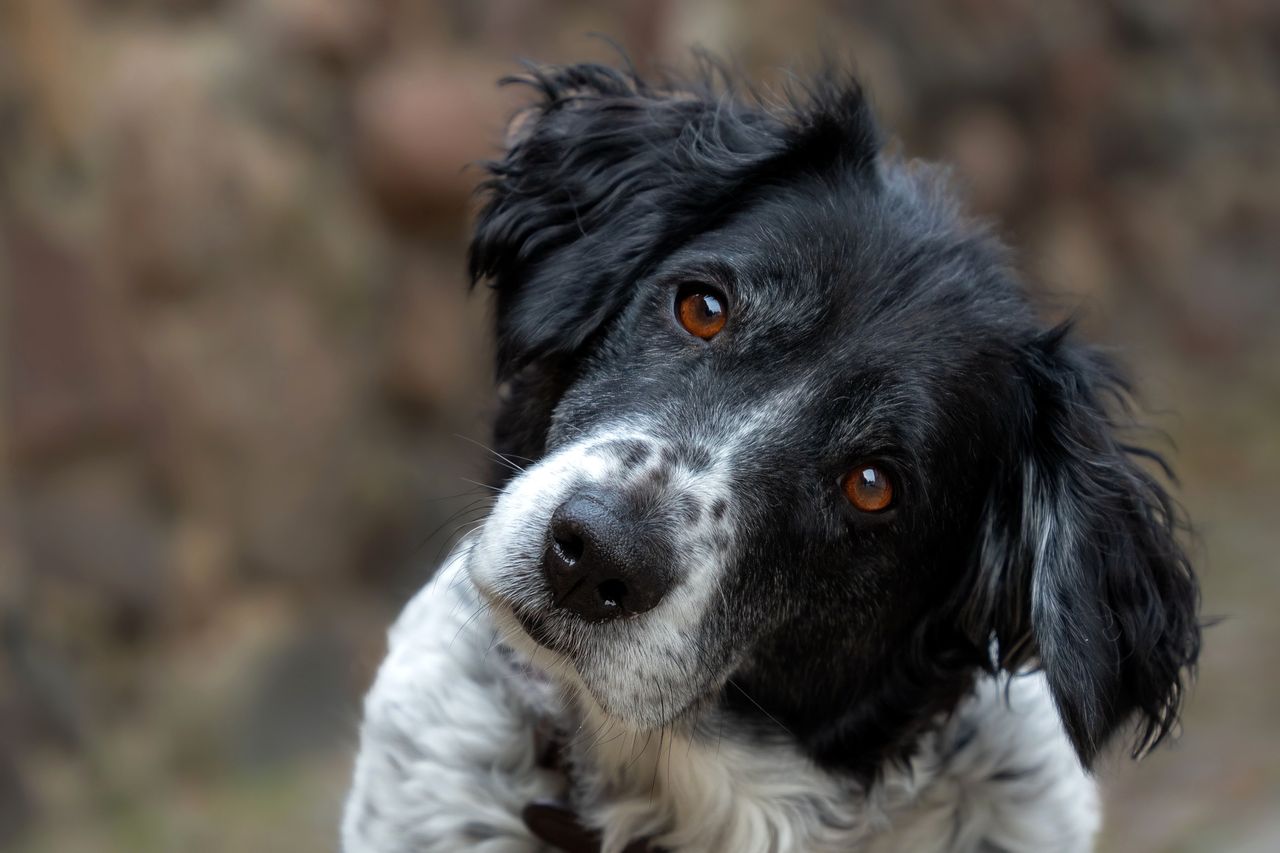
You say a certain word, maybe "walk" or your dog's name, and it happens. The ears lift, the head swivels to one side, and you get that quizzical look that seems to say, "Go on, I'm listening." It is one of the most charming things dogs do, and almost everyone who lives with one has stopped mid-sentence just to enjoy it.
It is easy to assume the head tilt is pure cuteness with no meaning behind it. The honest answer is more interesting. Researchers have started studying this exact behaviour, and while they have not settled it completely, the leading explanations suggest your dog is doing something genuinely thoughtful. There is also one version of the head tilt that is worth taking seriously rather than photographing, and it helps to know the difference.
Why this is worth understanding
For most of us, a dog is family, and part of caring for family is learning to read them. The head tilt sits right at the intersection of two useful things: understanding how your dog communicates, and noticing when something might be wrong.
Knowing what the tilt probably means helps you connect with your dog and reinforce the behaviour you enjoy. Knowing what an unusual tilt can signal helps you catch a health problem early. Both are small pieces of being a more attentive owner, and neither requires you to be an expert.
What is actually happening when your dog tilts
A dog tilting its head is not confused in the way the pose suggests to us. Most animal behaviour experts think the tilt is a sign of active engagement, an attempt to gather or make sense of information coming from you. Beyond that shared starting point, there are three main explanations, and they are not mutually exclusive. Your dog may be doing more than one at once.
They are fine-tuning what they hear
The oldest explanation is about sound. Dogs rely heavily on hearing, and the tilt may help them locate or interpret a noise. Dr. Jill Goldman, a certified applied animal behaviourist, leans towards interpretation over location. When you are right in front of your dog, it already knows where your voice is coming from, so she suggests the tilt helps it "get refinement on what is being said," picking out familiar words and the rising, affectionate tone people use with their pets (American Kennel Club).
Their own muzzle is getting in the way
The second explanation is about sight. Psychologist Stanley Coren proposed that a dog's muzzle can partly block its view of your lower face, and since dogs read our mouths and expressions to understand us, a small tilt clears the sightline. In an informal survey of owners, he found that dogs with longer muzzles tilted their heads more often than flat-faced breeds like pugs, which fits the idea (American Kennel Club). It was a rough survey rather than a controlled study, so treat it as a promising clue rather than a settled fact.
They have learned it pays off
The third explanation is the simplest. Dogs repeat what works. If tilting the head has often been followed by a delighted "good boy," a treat, or a walk, your dog learns that the pose brings good things and offers it more readily. As Goldman puts it, the tilt "most likely repeats because it's positively reinforced." This does not make it fake, it just means your reaction helps shape how often you see it.
What the evidence actually says
The most interesting recent clue comes from a 2021 study led by Andrea Sommese at Eötvös Loránd University in Hungary, published in the journal Animal Cognition. The team was studying "gifted word learner" dogs, a rare handful of dogs that can learn the names of dozens of toys. They noticed these dogs tilted their heads far more than others when they heard a familiar toy's name.
The numbers were striking. The gifted word learners tilted their heads in about 43 percent of trials when asked to fetch a toy they knew by name, while typical dogs tilted in only about 2 percent of trials. Even more telling, individual dogs tended to tilt to the same side every time, and that preference held steady across months of testing (Sommese et al., 2021).
The researchers' careful interpretation was that head tilting may reflect a dog concentrating on something meaningful, possibly matching a word it hears to a picture in its memory. In other words, when your dog tilts at the word "walk," it may be pulling up the mental image of its lead and the front door.
It is worth being honest about the limits here, which is exactly the sort of nuance the study's own authors flagged. The sample was tiny, only a handful of dogs, and they were all Border Collies. That is enough to make head tilting a genuine subject of science rather than folklore, but not enough to declare the mystery solved. The most accurate thing anyone can say today is that the tilt is very likely a sign of attention and processing, with hearing, vision, and habit all playing a part.
How to make the most of it
You do not need to train the head tilt, and you certainly should not force it. A few simple habits will encourage the natural version and deepen the connection behind it.
Talk to your dog like you mean it. The tilt shows up most when dogs hear words they recognise, so using consistent names for people, toys, and activities gives your dog more to latch onto.
Reward the moment gently. A warm voice or a bit of fuss when your dog tilts tells it that paying attention to you is worthwhile, which strengthens the behaviour without any pressure.
Play naming games. Teaching your dog the name of a favourite toy, then asking for it by name, taps into exactly the kind of word-to-memory matching the research points to. It is good mental exercise and good fun for both of you.
Notice which side they favour. There is no need to read anything into left versus right, but simply watching your dog closely is the point. Attentive owners spot changes sooner.
When a head tilt is not so cute
Here is the part that matters most. A quick, responsive tilt while you talk is a happy, healthy behaviour. A head that stays tilted to one side even when nothing is happening is a different thing entirely, and it can be a medical sign.
A persistent or sudden head tilt, especially alongside a loss of balance, circling, falling towards one side, reluctance to move, or rapid flicking eye movements, can point to conditions like an ear infection or vestibular disease, which affects a dog's sense of balance (VCA Animal Hospitals). These often come on suddenly. If you see a constant tilt with any of those other signs, treat it as a reason to call your vet rather than something to wait out. Many causes are treatable, and early attention gives the best outcome.
The simple rule: an in-conversation tilt that comes and goes is charming and normal. A tilt that will not go away deserves a vet's opinion.
Common mistakes to avoid
Assuming the tilt means your dog is confused. The evidence points the other way, towards attention and processing rather than puzzlement.
Trying to force or overtrain the pose. Repeatedly baiting your dog into tilting for photos can stress it and strains the natural, positive reason it happens.
Ignoring a tilt that does not go away. This is the one that matters. A constant head tilt is not the same as the cute conversational one, and it can be an early health signal.
Reading deep meaning into the direction. Individual dogs favour a side, but there is no reliable evidence that left or right tells you anything about mood or health.
Frequently asked questions
Do all dogs tilt their heads? No, and that is perfectly normal. Some dogs tilt often, some rarely, and some almost never. Breed, muzzle shape, personality, and how their owners respond all seem to play a part. A dog that does not tilt is not less intelligent or less bonded to you.
Does a head tilt mean my dog is smart? It is tempting to think so after the word-learner study, but that is not a fair conclusion. The study looked at a rare group of dogs and a small sample. Frequent tilting shows engagement, not a measurable IQ.
Why does my dog tilt more at certain words? Most likely because those words are meaningful to it. Words tied to favourite things, like "walk," "dinner," or a toy's name, tend to trigger more attention, and with it, more tilting.
Should I be worried if my dog tilts its head a lot? Not if it is the quick, responsive kind that happens when you talk or make an interesting sound. Be cautious only if the head stays tilted constantly or comes with balance problems, circling, or unusual eye movements, in which case see your vet.
Key takeaways
The head tilt is more than a photogenic quirk. The best current evidence suggests it is a sign of a dog paying close attention and trying to make sense of something meaningful, with better hearing, a clearer view of your face, and learned habit all likely contributing. A 2021 study even linked frequent tilting to dogs recognising familiar words, though the research is still young and far from the final word. Enjoy the tilt, talk to your dog often, and reward the moment. Just remember the one exception that matters: a head that stays tilted when nothing is going on, particularly with balance or eye problems, is worth a call to your vet rather than a photo.
Related PetalPoko articles
Why Does My Cat Sleep on Me? What the Science Actually Suggests
Why Does My Dog Follow Me From Room to Room?
How to Help Local Wildlife Without Accidentally Harming It
Sources and further reading
Sommese, A. et al. (2021), An exploratory analysis of head-tilting in dogs, Animal Cognition. https://link.springer.com/article/10.1007/s10071-021-01571-8
American Kennel Club, Why Do Dogs Tilt Their Heads? https://www.akc.org/expert-advice/advice/why-do-dogs-tilt-their-heads/
VCA Animal Hospitals, Vestibular Disease in Dogs. https://vcahospitals.com/know-your-pet/vestibular-disease-in-dogs