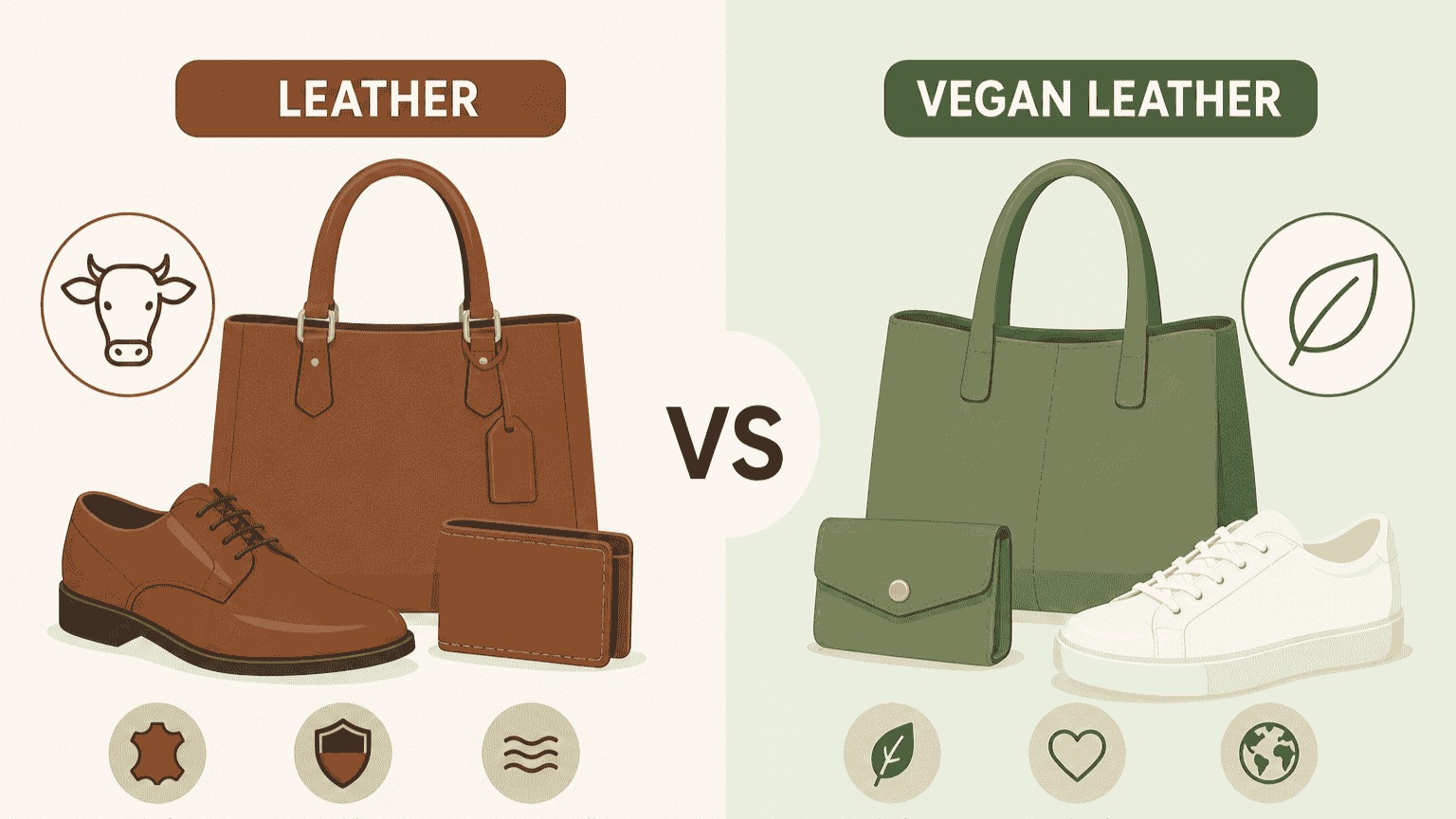
The choice that feels obvious until you look closer
You are standing in front of two wallets, or two pairs of boots, or two sofas. One is labelled leather. The other is labelled vegan leather, and something about that word makes it feel like the responsible pick. No animal, no harm, less guilt. You reach for it, and then a small question surfaces: what is vegan leather actually made of?
For many products on the market, the honest answer is plastic. That does not make it the wrong choice, and it does not make real leather the right one. It just means the comparison is more tangled than the labels suggest. So this lays out what is genuinely known, what is still uncertain, and how to weigh it for yourself.
Why this matters in everyday life
Leather goods are things you tend to keep. A belt, a bag, a jacket, or a car seat can stay in daily use for years, sometimes decades. That longevity is the whole point of the comparison, because a material's impact is spread across its entire life. A product that lasts fifteen years and one that lasts three can start with very different footprints and still end up in a very different place once you account for how often each needs replacing.
There is also a values layer worth naming plainly. Some people choose vegan materials because they do not want animals used for products at all. Others prioritise durability, repairability, or avoiding fossil-based plastics. These are legitimate and sometimes competing priorities, and no single material satisfies all of them at once. The aim here is not to tell you which value should win, but to give you accurate information so your choice matches what you actually care about.
What these materials actually are
Real leather is animal hide, usually cattle, that has been preserved through tanning so it does not rot. Most of it enters the supply chain as a byproduct or co-product of the meat and dairy industries, meaning the hides come from animals raised primarily for food. There is nuance to that framing, which the section below returns to.
The tanning step matters enormously. Around 80 to 85 per cent of leather worldwide is chrome-tanned, according to industry sources such as leather makers Selvane, a fast process that uses chromium salts and gives soft, water-resistant results. The alternative, vegetable tanning, uses plant tannins, takes weeks to months rather than a day, and produces a stiffer leather that ages into a patina.
"Vegan leather" is not one material but a category. The bulk of what is sold today is synthetic, made from polyurethane (PU) or polyvinyl chloride (PVC), both plastics derived from fossil fuels, usually coated onto a fabric backing. Green America describes conventional faux leather bluntly as essentially plastic. Then there is a newer group of plant-based alternatives: Piñatex from pineapple leaf fibre, mycelium or mushroom leather, Desserto from cactus, and cork. These are genuinely different from PU and PVC, but as the next section explains, most are not plastic-free.
What the evidence actually says
On durability, the general pattern reported across the trade is that quality real leather tends to outlast synthetic leather. Real leather can stay in use for many years or decades with care, while PU and PVC coatings are more prone to cracking, peeling, and delaminating, which can mean replacing an item sooner. This is central to the durability lens: if a leather bag lasts three times as long as a plastic one, its higher upfront impact is spread across three times the use. Durability is not a footnote to sustainability, it is often the deciding factor.
On chemicals, chrome tanning carries real environmental and occupational concerns where it is poorly managed. Untreated tannery wastewater can contain residual chromium, and although the chromium used in tanning is the less harmful trivalent form, it can oxidise into hexavalent chromium, which is toxic. Peer-reviewed work published in the journal Regulatory Toxicology and Pharmacology has examined how chromium is released from finished leather under different conditions. Modern tanneries with closed-loop treatment reduce these risks considerably, so the impact depends heavily on where and how the leather was made rather than on leather as such.
On fossil content and emissions, synthetic leathers start from oil and gas. On greenhouse gases alone, the picture is not one-sided: the Global Fashion Agenda has been cited, including by Green America, as finding that synthetic leather production releases less than half the greenhouse gas emissions of genuine leather, largely because cattle farming is emissions-heavy. That figure typically reflects manufacturing rather than the full lifespan, so a shorter-lived plastic that is replaced more often narrows or reverses the gap.
On microplastics, plastic-based vegan leather can shed synthetic particles as it wears and is slow to break down, and PVC in particular has been linked to hazardous additives. Researchers writing for The Conversation in 2026 argued that vegan leather is often not as sustainable or eco-friendly as marketing implies, precisely because so much of it is plastic.
The honest summary is that no material wins in every case. The real trade-offs are animal welfare and tanning chemistry on one side, and fossil plastics, shorter lifespans, and microplastics on the other, with plant-based options in between and still maturing.
On the plant-based newcomers, the promise is real but so are the caveats. Many still rely on a plastic binder to hold the plant fibres together and to give usable strength. Piñatex, for example, combines pineapple-leaf cellulose with a polyurethane resin, which is why, according to descriptions of the material, it will not fully biodegrade. Cactus and cork leathers are often bonded to cotton or polyester backings or finished with PU. Mycelium leather can be closer to plastic-free but has faced scaling difficulties, with some high-profile producers pausing or hitting production problems in recent years. These materials are early-stage, and long-term durability data is still thin, so it is fair to call them promising rather than proven.
How to choose, and how to make either last
If you have decided the material, the biggest lever is lifespan, so buy well and keep it long.
Prioritise construction and repairability over the material label. Stitched seams, replaceable soles, and solid hardware often matter more for total impact than whether something is leather or not.
If you choose real leather, ask about the tanning. Vegetable-tanned or certified chrome-tanned leather from tanneries with wastewater treatment reduces the chemical concerns. Certifications such as the Leather Working Group audit are worth looking for, with the usual caveat that a label describes a process, not a guarantee.
If you choose synthetic vegan leather, treat longevity as the goal. Keep it out of prolonged direct heat and sun, clean it gently, and avoid overstuffing bags, since cracking and peeling are the usual failure points.
If you are drawn to plant-based options, ask one plain question: what percentage is plant-based, and what is the binder? A material that is mostly plastic with a plant coating is closer to conventional faux leather than the branding suggests.
Whatever you own now, use it until it genuinely wears out. Replacing a functional item early almost always costs more in total impact than keeping it.
Common misconceptions to avoid
The most common one is that vegan automatically means greener. For animal welfare it is straightforward, but for environmental impact it depends on whether the vegan material is fossil-based plastic, how long it lasts, and how it is disposed of. Vegan and low-impact are not the same claim.
A second is that real leather is simply a free byproduct with no footprint of its own. Hides do use waste that already exists, but analyses cited by outlets such as Project Cece note that leather can add economic value to livestock, which complicates the pure-byproduct framing. Leather is not impact-free.
A third is that plant-based leather means plastic-free. As above, most current versions still contain a polymer binder or backing. That does not erase their potential, but it does mean the word plant-based is doing a lot of quiet work.
A fourth is that a single number settles it. A one-line carbon figure usually reflects one stage of production, not sourcing, durability, and end-of-life together, which is where the real comparison lives.
Frequently asked questions
Is real leather more sustainable than vegan leather? Neither is reliably better across the board. Real leather tends to last longer, which favours it on a per-year basis, but tanning chemistry and animal welfare are genuine concerns. Conventional vegan leather avoids the animal question but is usually plastic and often shorter-lived. The better answer depends on the product and how long you keep it.
Is vegan leather just plastic? Most of it currently is, in the form of PU or PVC. Plant-based versions exist and are different, but many still include a plastic binder, so it is worth checking the composition rather than trusting the name.
Does vegan leather shed microplastics? Plastic-based vegan leather can release synthetic particles as it wears and degrades, according to material researchers, though the quantities in everyday use are still being studied. Plant-based versions with a plastic component may shed less, but this is not yet well quantified.
Is chrome-tanned leather dangerous to use? Finished, well-made leather is generally considered safe in normal use. The stronger concerns relate to tannery workers and wastewater where the process is poorly controlled, and to hexavalent chromium forming under certain conditions. Vegetable-tanned or responsibly produced chrome-tanned leather reduces these concerns.
Are mushroom, cactus, and pineapple leathers worth buying? They are promising and worth supporting if they suit your needs, but they are early-stage, often contain some plastic, and lack long-term durability data. Treat them as an evolving option rather than a settled solution.
Key takeaways
Vegan does not automatically mean lower environmental impact. Most conventional vegan leather is fossil-based plastic, usually PU or PVC.
Durability is the quiet deciding factor. A longer-lasting material spreads its impact across more years of use, which is why quality real leather often performs well on a per-year basis.
Real leather's main trade-offs are tanning chemistry, mostly chrome tanning, plus land use and animal welfare, and its byproduct status is real but not absolute.
Plant-based alternatives such as Piñatex, cactus, cork, and mycelium are promising but usually still contain a plastic binder and are early-stage.
The most reliable move, whichever material you pick, is to buy something well made, care for it, and keep it in use for as long as you can.
Sources and further reading
The Conversation, "Vegan leather isn't as sustainable or eco-friendly as brands might claim" (2026): https://theconversation.com/vegan-leather-isnt-as-sustainable-or-eco-friendly-as-brands-might-claim-278548
Green America, "The Truth About Vegan Leather": https://greenamerica.org/your-green-life/truth-about-vegan-leather
Project Cece, "Leather vs Vegan Leather: What's ACTUALLY More Sustainable?": https://www.projectcece.com/blog/529/real-leather-vs-vegan-leather-comparison/
Wikipedia, "Plant-based leather": https://en.wikipedia.org/wiki/Plant-based_leather
Selvane, "Chrome vs. Veg Tanning: A Guide to Leather": https://www.selvane.co/blogs/knowledge/chrome-vs-vegetable-tanning-the-material-trade-offs
Devrn-Simsek et al. / Hedberg et al., "Chromium released from leather," Regulatory Toxicology and Pharmacology (PMC): https://pmc.ncbi.nlm.nih.gov/articles/PMC4415597/