The bottle you reach for without thinking
Most kitchens have one: the trigger spray that lives under the sink and gets used a dozen times a week. You point it at a worktop, wipe, and move on. Yet if you turn the bottle around and read the label, you often find very little. Sometimes a short list of chemical names, sometimes just the word "fragrance", sometimes nothing at all beyond a warning symbol.
That gap between how often you use these products and how little the label tells you is worth closing. Not because the spray is secretly dangerous, but because understanding what is inside helps you use it well and avoid the few genuine mistakes that matter.
Why this matters in everyday life
You spend a lot of time indoors, and the air in your home is not always cleaner than the air outside. The US Environmental Protection Agency notes that levels of several common organic pollutants average two to five times higher indoors than outdoors, and that using products such as cleaners can push levels far higher for a short while.
Cleaning is one of those activities. The American Lung Association points out that many cleaning supplies release compounds that can contribute to headaches, allergic reactions, and respiratory irritation, particularly in a poorly ventilated room. This does not mean you should stop cleaning or feel anxious every time you pick up a spray. It means the sensible response is simple: know what the product is, and give the room some air.
There is also a transparency point. Unlike food and cosmetics, household cleaners sold in the United States are not required by federal law to list their ingredients, according to the Environmental Working Group. So part of understanding your spray is learning to read what is there, and to notice what is missing.
Why cleaning sprays contain what they do
A cleaning spray has a handful of jobs. It has to loosen grease, spread evenly across a surface, sometimes kill germs, stay stable on the shelf for months, and often leave a pleasant smell. No single chemical does all of that, so a typical formula is a small team of ingredients, each with a role.
It also helps to know that most sprays are mostly water. Water carries everything else and does a surprising amount of the cleaning on its own, so the active ingredients are usually a minority of the bottle by weight. Understanding the groups below, rather than memorising individual chemical names, is the quickest way to make sense of almost any label.
What is actually in the bottle
Surfactants are the workhorses. The word is short for "surface active agents", and they are the reason water can lift away grease it would otherwise bead off. A surfactant molecule has one end that likes water and one end that likes oil, so it surrounds greasy dirt and lets you rinse or wipe it away. They are the same family of ingredient that makes soap and washing-up liquid foam. On a label they may appear under names ending in "-eth" or as terms like alkyl sulfates.
Solvents help dissolve dirt that water alone cannot shift, especially oily or sticky residues, and they help the product dry without streaks. Glycol ethers are a common example in glass and multi-surface cleaners. One widely used member of the group, 2-butoxyethanol, appears in many degreasers and window sprays. According to the US Agency for Toxic Substances and Disease Registry, breathing high concentrations of 2-butoxyethanol can cause irritation and other effects, one practical reason to ventilate and avoid using strong degreasers in an enclosed space.
Disinfectants are added when a product is meant to kill germs rather than just clean. The two you meet most often are bleach and quats. Bleach is usually sodium hypochlorite, the same chlorine-based chemical used to whiten and sanitise. Quats, short for quaternary ammonium compounds, are a group the American Cleaning Institute describes as working by binding to the outer membranes of microbes and disrupting them. They appear in many disinfecting wipes and sprays under names such as benzalkonium chloride. It is worth knowing that a disinfectant only works if it stays wet on the surface for the "contact time" stated on the label, often several minutes.
Ammonia turns up in some glass and multi-surface cleaners because it cuts through grease and dries to a streak-free finish. It has a sharp, distinctive smell, and it is the ingredient behind one of the most important safety rules in this whole article, which comes up in the mistakes section below.
Fragrance, or "parfum", is what gives a spray its lemon, pine, or "fresh linen" smell, and here is the honest part: a single "fragrance" listing can stand in for many separate chemicals. The Environmental Working Group notes that the scents added to cleaners and other goods may draw on more than 3,000 possible ingredients, and that companies are generally not required to name them individually because fragrance blends are treated as trade secrets. Most people tolerate fragrance without any trouble, but if you are sensitive, get headaches, or have asthma, an unscented product removes an unknown you cannot otherwise inspect.
Preservatives stop bacteria and mould growing inside a water-based bottle during its months under your sink. Without them the product could spoil. They are present in small amounts, but some, such as certain isothiazolinones, are known skin sensitisers for a minority of people, which is why they appear on ingredient lists where those are provided.
pH adjusters keep the product acidic or alkaline depending on the job. Alkaline formulas suit grease and general grime, while acidic ones such as citric acid tackle limescale and mineral deposits. This is also why some cleaners are labelled for specific surfaces, since the wrong pH can damage stone or certain finishes.
A word on VOCs. Several of the groups above, especially solvents and some fragrance components, are volatile organic compounds. The EPA defines these as chemicals emitted as gases from certain solids or liquids, and they are the main reason cleaning affects indoor air. VOCs are not a separate secret ingredient. They are a property shared by many ingredients already on the label, which is why ventilation matters more than any single chemical name.
How to read a label and clean safely
You do not need a chemistry degree to make good decisions. A few habits cover most of it.
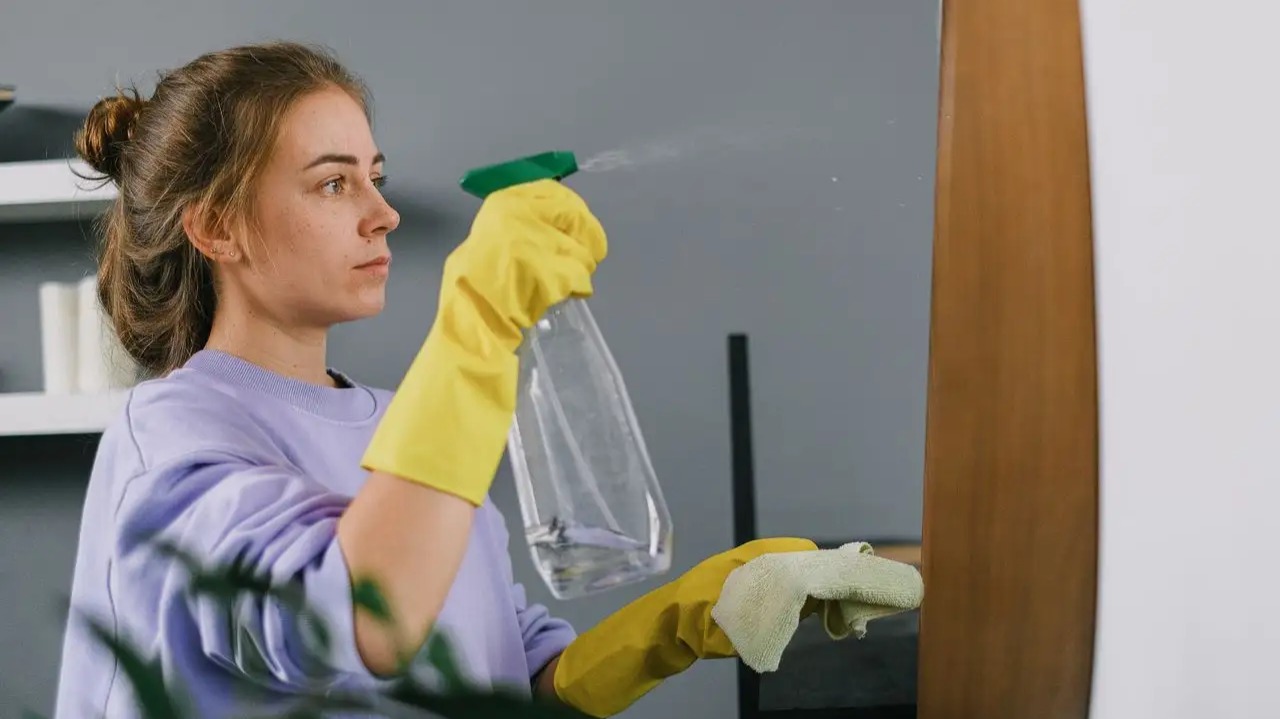
Ventilate every time. Both the EPA and the American Lung Association recommend increasing ventilation when you use cleaning products. Open a window or door, and never use them in a small, closed space. This is the single most effective thing you can do.
Match the product to the job. A disinfectant is only needed where germs are a real concern, such as after handling raw meat. For everyday dirt, the American Lung Association notes that warm water and soap handle a great deal.
Respect the contact time. If you want a disinfectant to work, let it stay wet on the surface for as long as the label says, then wipe.
Follow the label instructions and warnings. They exist for a reason, including dilution rates and any advice to rinse food-contact surfaces afterwards.
Choose unscented if you are sensitive. It removes the one ingredient group you cannot inspect.
Look for meaningful certification, not slogans. In the United States, the EPA's Safer Choice label means EPA scientists have reviewed every ingredient against health and environmental criteria. In the European Union, the Detergents Regulation requires certain ingredient groups, and fragrance allergens above set thresholds, to be declared, so labels there tend to tell you more. A recognised certification is more informative than a marketing word.
Store safely. Keep products in their original bottles, away from children and pets.
Common mistakes to avoid
Mixing bleach with ammonia, or with acids. This is the one rule to remember above all others. The American Lung Association warns that you should never mix bleach, or any bleach-containing product, with a cleaner containing ammonia, because the gases produced can cause serious breathing problems and in extreme cases can be fatal. The same caution applies to mixing bleach with acidic cleaners such as some limescale removers. Do not combine cleaning products hoping for extra power, and rinse a surface before switching from one product to another.
Assuming "natural", "green", or "non-toxic" are regulated promises. They are largely not. These words have no single agreed legal definition on cleaning products, and the US Federal Trade Commission's guidance on environmental claims warns against unqualified, unsubstantiated marketing terms. "Natural" does not automatically mean gentle, and "chemical-free" is not literally possible, since water is a chemical. Treat these words as a starting point, then look for an ingredient list or a real certification.
Cleaning in a sealed room. Wiping a bathroom with the door shut concentrates exactly the VOCs you want to disperse. Air first, or air as you go.
Using more product than needed. More spray does not mean more clean. It usually means more residue and more to breathe.
Decanting into unlabelled bottles. This makes accidental mixing and accidental swallowing far more likely, especially where children are around.
Frequently asked questions
Are cleaning sprays dangerous to have at home? Used as directed, in a ventilated room, common household sprays are designed to be safe for their intended purpose. Problems tend to come from misuse, poor ventilation, or combining products, so the sensible response is caution and airflow rather than fear.
Is "fragrance" on the label something to worry about? For most people it causes no issue. The honest concern is transparency, since one "fragrance" listing can represent many undisclosed chemicals, as the Environmental Working Group describes. If you have asthma, allergies, or sensitive skin, an unscented product is a reasonable choice because it removes that unknown.
Do I need a disinfectant for everyday cleaning? Usually not. Disinfectants are useful in specific situations, such as after preparing raw meat or during illness. For routine dirt, soap and water do most of the work, according to the American Lung Association.
Are "natural" or "eco" cleaners actually safer or better for the environment? They may be, but the label alone does not prove it. These terms are largely unregulated, so the honest answer depends on the actual ingredients and a credible certification such as EPA Safer Choice, not on the marketing word itself.
Why do sprays smell so strong even after I have finished? That lingering smell is partly VOCs evaporating into the air. The EPA notes that using such products can raise indoor VOC levels temporarily, and the smell fades faster with a window open.
Key takeaways
A typical cleaning spray is mostly water plus a small team of ingredient groups: surfactants to lift grease, solvents to dissolve residue, sometimes disinfectants, sometimes ammonia, plus fragrance, preservatives, and pH adjusters.
Several of these are volatile organic compounds, which is why cleaning affects indoor air and why ventilation is the most useful habit you can adopt.
In the United States, cleaners are not legally required to list their ingredients, and "fragrance" can stand in for many undisclosed chemicals, so learning to read labels and look for real certification matters.
Never mix bleach with ammonia or with acids, because the gases can be seriously harmful.
"Natural", "green", and "non-toxic" are largely unregulated marketing terms. Judge a product by its ingredients and a credible certification, not its slogans.
Sources and further reading
US Environmental Protection Agency, Volatile Organic Compounds' Impact on Indoor Air Quality: https://www.epa.gov/indoor-air-quality-iaq/volatile-organic-compounds-impact-indoor-air-quality
US EPA, Safer Choice frequently asked questions: https://www.epa.gov/saferchoice/frequently-asked-questions-safer-choice
American Lung Association, Cleaning Supplies and Household Chemicals: https://www.lung.org/clean-air/indoor-air/indoor-air-pollutants/cleaning-supplies-household-chem
American Lung Association, Volatile Organic Compounds: https://www.lung.org/clean-air/indoor-air/indoor-air-pollutants/volatile-organic-compounds
Environmental Working Group, Secret Ingredients, Hidden Hazards: https://www.ewg.org/cleaners/content/secret-ingredients/
American Cleaning Institute, Quaternary Ammonium Compounds FAQ: https://www.cleaninginstitute.org/understanding-products/disinfectants/quaternary-ammonium-compounds-faq-common-disinfectant
Agency for Toxic Substances and Disease Registry, 2-Butoxyethanol ToxFAQs: https://wwwn.cdc.gov/TSP/ToxFAQs/ToxFAQsDetails.aspx?faqid=346&toxid=61
US Federal Trade Commission, Green Guides (environmental marketing claims): https://www.ftc.gov/news-events/topics/truth-advertising/green-guides
European Union, Regulation (EC) No 648/2004 on detergents: https://eur-lex.europa.eu/legal-content/EN/TXT/?uri=CELEX:32004R0648